• Home
  • Awards
  • Books
    • Edited Volumes
    • Book Chapters
    • Journal Articles
    • Book Reviews
  • Lectures
  • Conferences
  • Teaching
  • Galleries
  • Links
  • Contact
  • News

Joseph M. Conte

~ Professor of English, University at Buffalo

Joseph M. Conte

Author Archives: Joseph Conte

English 447: The Literature and Film of Immigration

11 Wednesday Mar 2015

Posted by Joseph Conte in Teaching

≈ Leave a comment

Tags

Literature and Film of Immigration

University at Buffalo

Fall 2015

Online Course

Mulberry Street, New York City (c. 1900)

Mulberry Street, New York City (c. 1900)

The path of immigration into the United States extends from the halls of Ellis Island to the globalized migration of the twenty-first century. First-generation immigrants are often driven to these shores by the blight of poverty or the sting of religious or political persecution; hope to make for themselves a fabled but often factitious “better life”; and are riven between the desire to retain old-world customs and language and the appeal of new-world comforts and technological advances. Second-generation immigrants face the duality of a national identity—striving to become recognized as “real Americans”—and an ethnic heritage that they wish to honor and sustain but which marks them as always an “other.” Here we encounter the hyphenated status of the preponderance of “natural born” American citizens. The third-generation descendent will have only indirect or acquired familiarity with his or her ethnic heritage; the loss of bilingualism or at best a second language acquired in school; and frequently a multiethnic identity resulting from the complex scrabble of American life in a mobile, suburban, and professionalized surrounding.

We will view films and read a selection of both fiction and memoir that reflect the immigrant experience in this country. Jacob Riis documents the penury and hardship of tenement life among the newly arrived underclass in How the Other Half Lives (1890). Anzia Yezierska’s novel Bread Givers (1925) treats the conflict between a devout, old-world Jewish father and a daughter who wishes to be a modern independent woman. We’ll want to compare Yezierska’s immigrant experience of 1900 with the Soviet-era migration of Russian Jews to New York in Gary Shteyngart’s comic autobiography Little Failure (2014). Mount Allegro (1989), Jerre Mangione’s memoir of growing up in the Sicilian enclave of Rochester, NY, portrays ethnicity that is insular, protective of its “imported from Italy” values, and yet desperate to find recognition as an authentic version of “Americanness.” The film Big Night (1996), directed by Campbell Scott and Stanley Tucci, serves up Italian food with abbondanza, “rich abundance,” but not a single Mafioso. In his long career as an English teacher and barroom raconteur, Frank McCourt preserved the harrowing story of his youth in Limerick, Ireland and New York for Angela’s Ashes (1997) and ‘Tis (1999); like so many immigrant families, the McCourts re-emigrated between transatlantic failures. We’ll screen the film adaptation of Angela’s Ashes, directed by Alan Parker, and read the second volume of his autobiography. Junot Díaz, in The Brief Wondrous Life of Oscar Wao (2007), follows the “Ghetto Nerd,” his voluptuous sister and hot-tempered mother between urban-industrial Paterson, New Jersey and their Dominican homeland. Finally, we’ll view the docufiction film, Who Is Dayani Cristal? starring Gael García Bernal and directed by Marc Silver, which retraces the journey made by a migrant laborer whose desiccated body was found in Arizona’s forbidding Sonora Desert.

Who Is Dayani Cristal?

Who Is Dayani Cristal?

As this is an exclusively online course, our discussion of these books and films will take place in the UB Learns environment. Writing assignments on ethnicity, identity and migration will be shared and critiqued among class members in the UB Learns discussion boards throughout the semester.

English 383A: Transnational Politics and the Post-9/11 Novel

24 Saturday Jan 2015

Posted by Joseph Conte in Teaching

≈ Leave a comment

Tags

Post-9/11 Literature

Spring 2015

University at Buffalo

Beyond Globalization: Beijing, China

Beyond Globalization: Beijing, China

Literature after September 11, 2001 reflects a shift from the provincial politics of nation-states to that of transnational politics—issues that require adjudication across national, geographic, cultural, linguistic, religious, and racial borders. In the epoch of globalization, these are conflicts that are unlikely to be resolved without the cooperation and understanding of diverse peoples willing to set aside sectarian interests. If the collapse of the Soviet Union in 1991 brought to a close an overt dichotomy in international politics and deprived Western writers of a reliable foil, the events of 9/11 not only redirected our “intelligence community” from counter-espionage to counter-terrorism but also compelled writers to attend to a multilateral political terrain. This new political paradigm is both transnational and asymmetrical. The system of global capitalism, for which the secular ideals of representative democracy are a thinly disguised “advance man,” contends with the emergent threat of a transnational theocracy that is resistant to the agnostic, graphical, and consumerist Western ideology.

Chris Corder (2001): 911 Apocalypse

Chris Corder (2001): 911 Apocalypse

We will read some works of fiction that directly represents the events of 9/11 and others that reflect changes in the political and cultural milieu in its aftermath. Don DeLillo has called this the “Age of Terror,” and in Falling Man (2007), he eschews documentary realism in favor of representing 9/11 through the cognitive and psychological trauma of a World Trade Center survivor whose recuperation is the beginning of a “counternarrative” to terrorism. Orhan Pamuk sets Snow (2004) in the village of Kars in far eastern Turkey, away from the multicultural city of Istanbul that links Europe and Asia, in order to foreground the tensions and resistance between Islam and Turkey’s secular state as girls, forbidden to wear head scarves to school, commit suicide. J. M. Coetzee, in Diary of a Bad Year (2007), fashions a multi-tracked narrative in which the author-surrogate Señor C. ventures a series of “strong opinions” on anarchism, terrorism, the state, Al Qaida, democracy and so on that question the purpose of writing in an ethically confused and disputatious world.

Graydon Parrish, The Cycle of Terror and Tragedy, 2002-2006 September 11th, 2001

Graydon Parrish, The Cycle of Terror and Tragedy, 2002-2006 September 11th, 2001

These and other works of contemporary fiction—including Ken Kalfus, A Disorder Peculiar to the Country (2006), Ian McEwan’s Saturday (2005), Amy Waldman’s The Submission (2011), and Mohsin Hamid’s The Reluctant Fundamentalist (2008)—suggest that, rather than suffering from self-absorption and disaffection, innovative fictions have engaged global politics. As Pamuk contends, it is through novels that world citizens do their deepest thinking about themselves.

Kathryn Bigelow, dir. Zero Dark Thirty (2012)

Kathryn Bigelow, dir. Zero Dark Thirty (2012)

We’ll also screen films that present differing views of the role of state power in the transnational political drama, including Kathryn Bigelow, dir. Zero Dark Thirty (2012), Alain Brigand, prod. 11’09″01 September 11 (2002), and Errol Morris, dir. Standard Operating Procedure (2008).


English 353: Experimental Fiction: Multimodality in the Novel

24 Saturday Jan 2015

Posted by Joseph Conte in Teaching

≈ 1 Comment

Tags

Experimental Fiction

Mel Bochner, Language Is Not Transparent (1970)

Mel Bochner, Language Is Not Transparent (1970)

Spring 2015

University at Buffalo

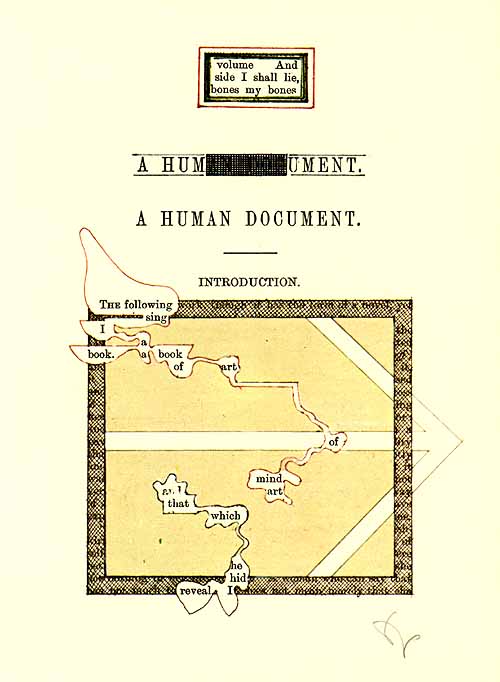
We will read a selection of “books” that question every aspect of what it means to be a print novel. These are multimodal works that integrate text, pictures and design elements; and yet they are books you can’t read on a Kindle™. We experience multimodality as the environment of our daily life, in various platforms that include the urban streetscape, art galleries, digital “desktops” and other electronic media. Multimodality is as new as the iPhone with its “app” icons and voice assistant, Siri, but as old as the New England Primer. Multimodal literature both resists and appropriates digital technology in the print medium. Most literary works are language-centered: they call on the reader’s store of linguistic competency and comprehension of the text, but they subordinate or exclude pictorial or graphic elements. The experience of reading a multimodal novel, however, requires that the reader negotiate between the verbal and the visual, always aware that the bound book is also an expert technology. We will examine the effects of multiple reading paths on narrative structure; the physical manipulation required to read these books; and the “self-conscious” reading that is required by works that call attention to themselves as books.

Tom Phillips, A Humument

Tom Phillips, A Humument (1980)

Works for extended discussion will include: Mark Z. Danielewski’s Only Revolutions (2006); Jonathan Safran Foer’s Tree of Codes (2010); B. S. Johnson’s The Unfortunates (2009); Vladimir Nabokov’s The Original of Laura (Dying is Fun) (2008); Tom Phillips’s A Humument: A Treated Victorian Novel (fifth edition, 2012); Art Spiegelman’s MetaMaus: A Look Inside a Modern Classic (2011); and Steve Tomasula’s VAS: An Opera in Flatland (2004).

English 357: Film Adaptation of the Novel

24 Saturday Jan 2015

Posted by Joseph Conte in Teaching

≈ Leave a comment

Tags

Contemporary Literature

Winter Session 2015

University at Buffalo

Cloud Atlas

This installment of Contemporary Literature will examine film adaptations of the novel. Literary fiction provides a rich, original source for story, character and setting in feature films. And yet the director, screenwriter, and actors are inevitably faced with challenges in successfully transferring a predominantly textual art into a visual and auditory medium. Especially with well-known classic works such as F. Scott Fitzgerald’s The Great Gatsby (1925), recently adapted by director Baz Luhrman, the problem of fidelity to the original novel arises. The editing of long prose fictions to fit within the typical two-hour duration of feature films gives the most gifted screenwriter migraines. Sometimes, however, a script must be augmented with scenes or characters not present in the original for a coherent representation of the story on screen. Literature that heavily relies on interior monologue and narration rather than external dramatic action or dialogue poses a nearly insurmountable hurdle for adaptation. And we should consider that novels are most often sole-authored works of the imagination that, in the words of Irish writer and humorist Flann O’Brien, are “self-administered in private,” while films are very much collective enterprises demanding the skills of hundreds of people and, ideally, screened in public theaters to large appreciative audiences. In this compressed winter session we will have time to consider carefully two bestselling and critically acclaimed novels and their nearly as successful film adaptations. We’ll first read David Mitchell’s Cloud Atlas (2004), with its six overlapping storylines and recurrent characters; and we’ll view its ambitious adaptation by directors Tom Tykwer, Andy and Lana Wachowski (The Matrix Trilogy) in 2012. AtonementThen we’ll read Ian McEwan’s historical novel of class and moral responsibility, Atonement (2001), set in England in 1935, during World War II, and in present day England. Its adaptation by director Joe Wright in 2007 confronts the multiple historical settings and the complex subjectivity of the novel’s characters. This course will be conducted online through UB Learns, with digital streaming of the films. Students will be required to participate in weekly graded discussion boards and writing assignments on both novels and films.

Lost Identity in the Sonora Desert

13 Monday Oct 2014

Posted by Joseph Conte in Events

≈ Leave a comment

Tags

Buffalo Humanities Festival

UB Spectrum


On Thursday, the Buffalo Humanities Festival began the “Migration Nation: Moving Stories” with “Who is Dayani Cristal?,” a documentary looking at the journey immigrants make along the U.S.-Mexican border. Derek Drocy, The Spectrum

Lost identity in the Sonora Desert

“Who is Dayani Cristal?” film starts the Buffalo Humanities Festival

By SHAROL SHAMSOR

On September 30, 2014

Arizona Border Police found a decomposing, unidentifiable male body deep in the Sonora Desert. Underneath the deceased man’s shirt, officers found the words “Dayani Cristal” tattooed on his chest.

On Thursday, the story of immigrants’ journeys crossing the American border made its way from the West Coast to UB’s Center for the Arts. UB screened the documentary “Who is Dayani Cristal?” as part of the preliminary events for the first Buffalo Humanities Festival. The documentary, which won an award for cinematography at the Sundance Film Festival in 2013, followed Humanities Festival theme of “Migration Nations: Moving Stories.” The screening also hosted a discussion to talk about the significance of the documentary.

The film, directed by Marc Silver, follows a nameless migrant who tried travel to American from Honduras. In the end, the man perished in the sun-blistered Sonora Desert in the Southwestern United States. The tattoo was the only clue to his identity.

Tanya Shilina-Conte, a UB professor with Ph.D. in English, introduced the film and said the United States-Mexico border is the most frequently crossed border in the world. She said attempting to cross is “not worth” risking anyone’s life. The Sonora Desert is located in the western part the United States-Mexico border, connecting Mexico with Southeastern California and Southern Arizona. Within the past decade, the Sonora Desert has been the most traveled route along the United States-Mexico border.

“The Sonora desert’s extreme climate, temperatures reach as high as 180 Fahrenheit and then [drop] suddenly to 50 Fahrenheit,” make it “one of the deadliest stretch of land on the planet,” Shilina-Conte said.

The extreme temperatures, however, do not deter people trying to cross the border. “[The] economic needs and desires continue to beckon people to take the ultimate risk,” she said.

Joseph Conte, an English professor at UB and Shilina-Conte’s husband, held a one-hour discussion after the film screening ended. Conte began the discussion by reminding viewers of one of the film’s most powerful quotes from a friend of the nameless migrant. The quote questioned the United States’ billion-dollar investment in the United States-Mexico border, claiming it was an inanimate and dead investment and the money could instead be used to help human beings.

To hone the issue of immigration back to Buffalo, Conte also spoke of the apples at Wegmans. He said he wondered who would stop to think of the migrant workers who gather the fruits. He asked who would even realize the blue-collar labor face is “brown” in the United States.

The audience’s commentary on blue-collared immigrants sparked a discussion centered on xenophobia, a dislike or fear of people from other countries.

The documentary had shots of a “mass grave” – lockers in a morgue containing ashes – present in the United States. The ashes are of the unidentified illegal immigrants who attempted to cross the United States-Mexico border but died because of the journey across the desert, Conte said.

“I don’t want to be associated with a mass grave,” Conte said. “I don’t want the United States to have the mass grave of people on our hands or under our feet.” Conte said if America’s investment toward U.S.-Mexico border wall keeps growing, attempts to cross the wall could lead to more deaths.

The screening ended and many of the participants left with plenty to think about – an impact that Shilina-Conte intended.

After the discussion ended, Conte said it was a “very spirited discussion of the crisis of immigration” and “we are trying to understand for ourselves what roles we play in that drama as Americans.”

“I think that most of us would prefer to not think about [immigration],” Conte said. “But the crisis and the conditions, that are described by ‘Who is Dayani Cristal?’ are the crisis and the conditions that all of our parents, grandparents and great grandparents, faced at some point in the past. I guess you could say that a film like this, raises the consciousness of us, as Americans, as to the cost of migration and immigration.”

Paolo Antypas, a junior communication major, thought the film screening was an important part of the Buffalo Humanities Festival as well as to the world because of refugee problems in Syria and Iraq.

“The discussion at the end, not only helped us give our points out but also listen to the other’s points,” Antypas said. “And the most important thing is to get an opinion and conceptualize what you believe is the right way to go about solving something like this.”

UB Spectrum Interview after Screening of Who Is Dayani Cristal?

04 Saturday Oct 2014

Posted by Joseph Conte in Events

≈ Leave a comment

Tags

Buffalo Humanities Festival, Gael Garcia Bernal

Sharol Shamsor graciously reported on our screening and discussion of Who Is Dayani Cristal? for the UB Spectrum. It didn’t seem like the post-screening discussion of the immigration crisis and rising fatalities along our border with Mexico lasted an hour–but it may have been that long after Sharol interviewed us for this piece.

http://www.ubspectrum.com/news/view.php/849972/Lost-identity-in-the-Sonora-Desert

Who Is Dayani Cristal?

Who Is Dayani Cristal?

Who Is Dayani Cristal?

Who Is Dayani Cristal?


Buffalo Humanities Festival Talk

29 Monday Sep 2014

Posted by Joseph Conte in Events

≈ Leave a comment

Tags

Buffalo Humanities Festival

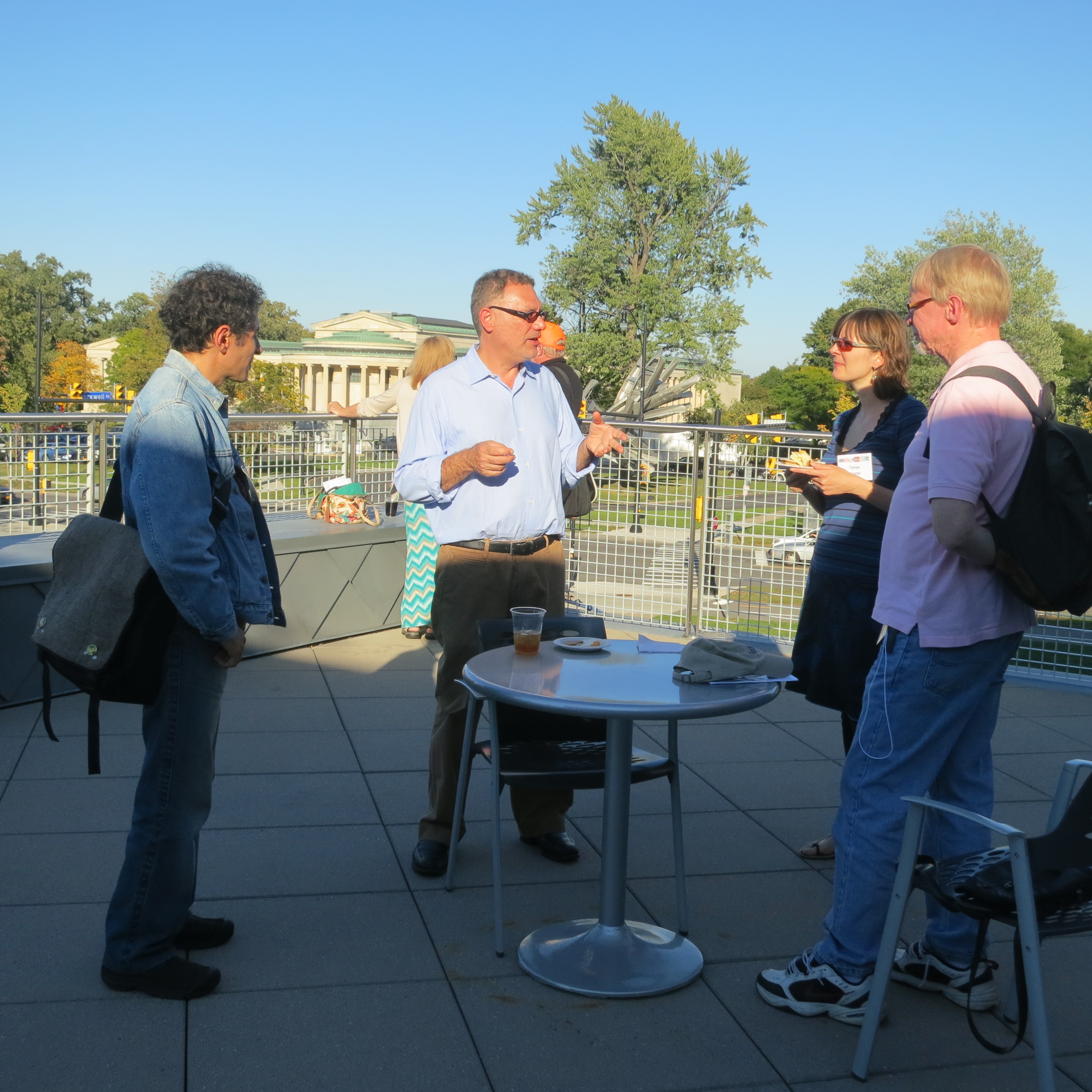
As part of the day-long series of talks, musical performances, dance, and world foods in the Buffalo Humanities Festival, I presented “Immigration Literature and the Alien Nation,” featuring three generations of Russian emigre writers, Anzia Yezierska, Vladimir Nabokov, and Gary Shteyngart.

Immigration Literature and the Alien Nation

Immigration Literature and the Alien Nation


Humanities Festival Reception

Humanities Festival Reception

Gary Shteyngart Reading, Albright Knox Art Gallery

29 Monday Sep 2014

Posted by Joseph Conte in Events

≈ Leave a comment

Tags

Buffalo Humanities Festival, Gary Shteyngart, Tanya Shilina-Conte

The highlight of the Buffalo Humanities Festival was the reading and on-stage interview (with David Schmid) of the very funny and engaging Gary Shteyngart. Shteyngart read from his memoir, Little Failure.

Screening and Discussion of Who Is Dayani Cristal?

29 Monday Sep 2014

Posted by Joseph Conte in Events

≈ Leave a comment

Tags

Buffalo Humanities Festival, Gael Garcia Bernal

As part of the Buffalo Humanities Festival, Tanya Shilina-Conte and I screened Who Is Dayani Cristal? starring Gael Garcia Bernal and directed by Marc Silver, on Thursday, September 25. The large and receptive audience engaged in a very spirited discussion of our country’s failed immigration policies and the 2,000 confirmed deaths of migrants in the Sonora Desert since 2000. “Dayani Cristal” was but one whose desiccated body could be identified. The film tells his story.

Dayani Cristal Post-Screening Discussion

Dayani Cristal Post-Screening Discussion

Who Is Dayani Cristal?

Who Is Dayani Cristal?

Buffalo Humanities Festival Book Group at Betty’s Restaurant

23 Tuesday Sep 2014

Posted by Joseph Conte in Events

≈ Leave a comment

Tags

Buffalo Humanities Festival, Gary Shteyngart

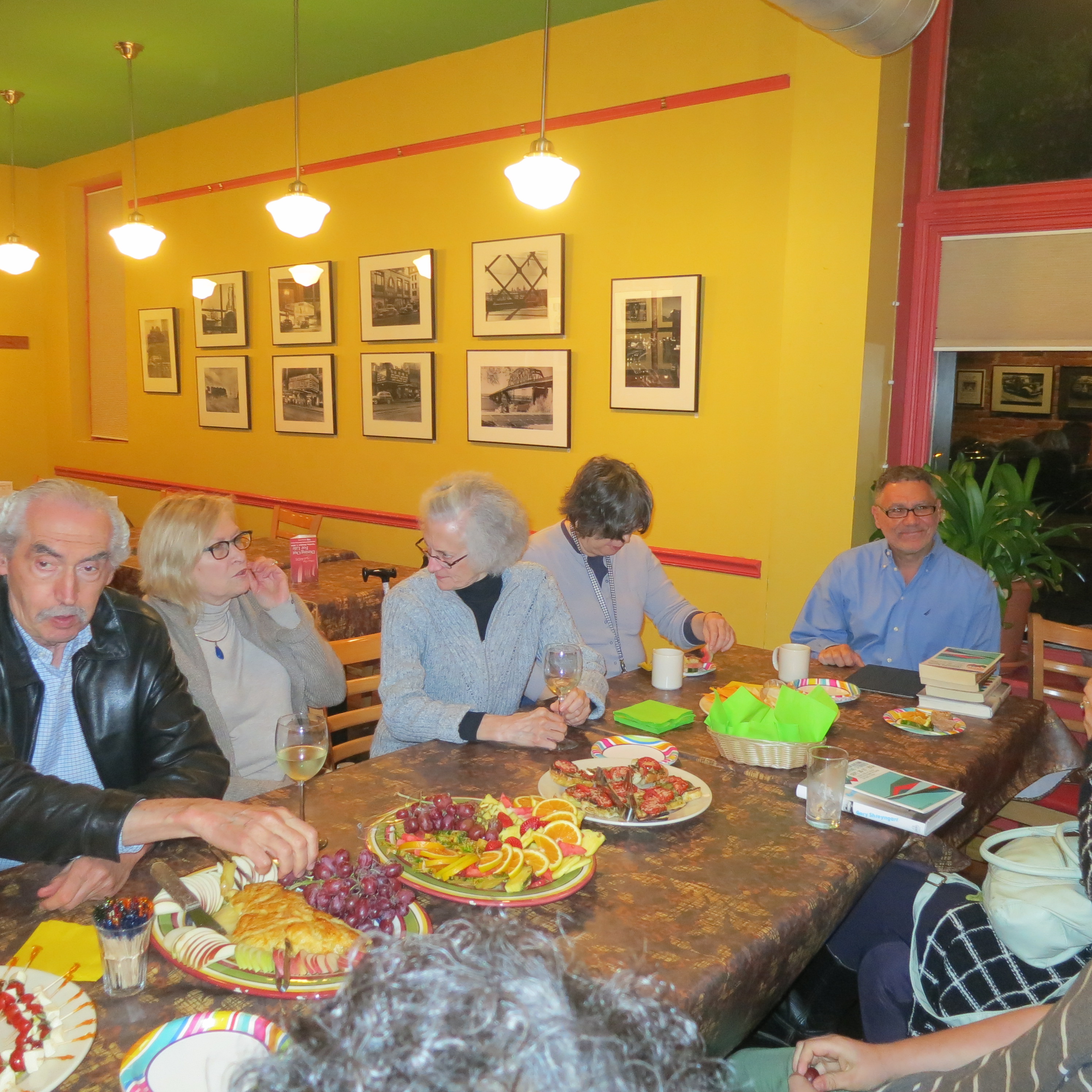
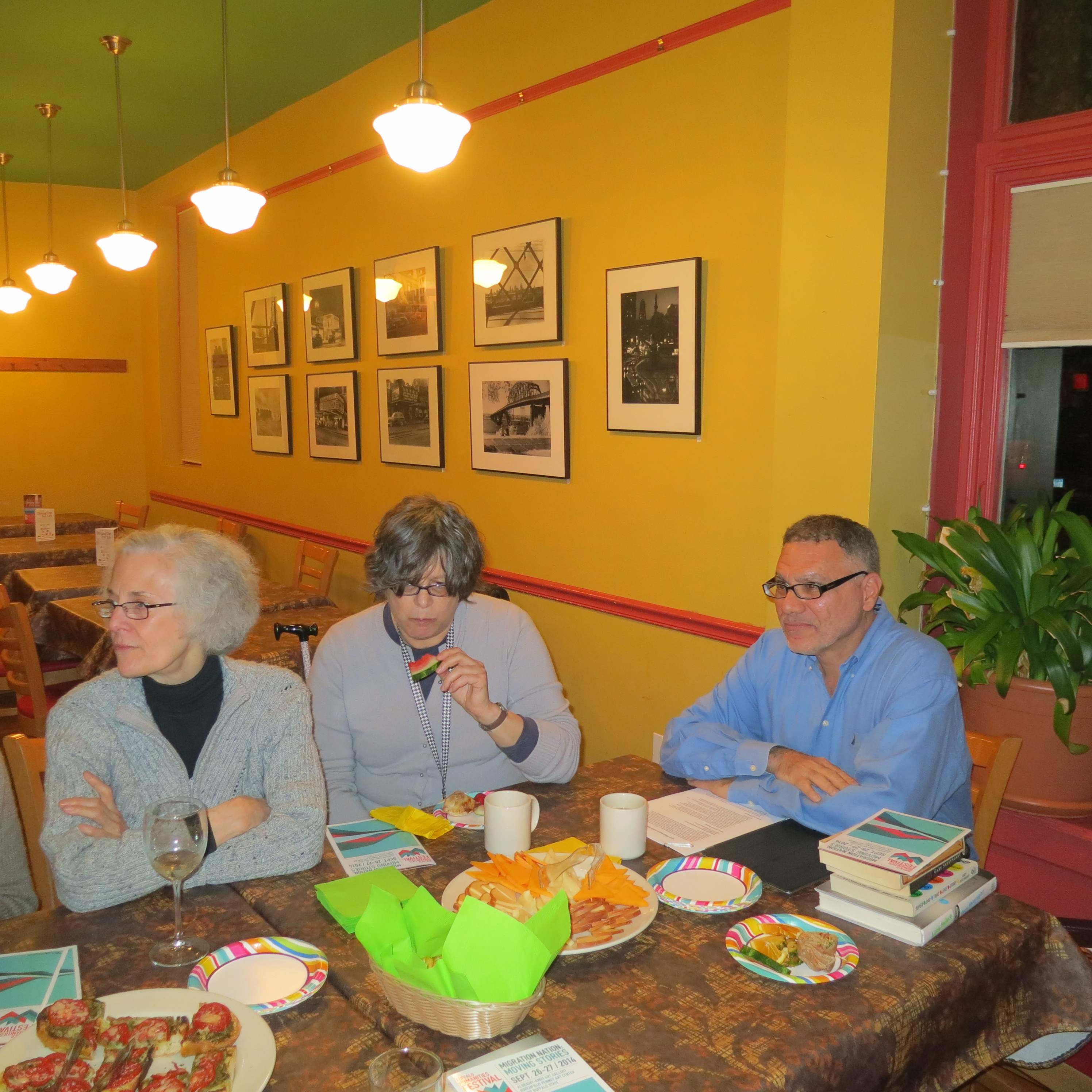
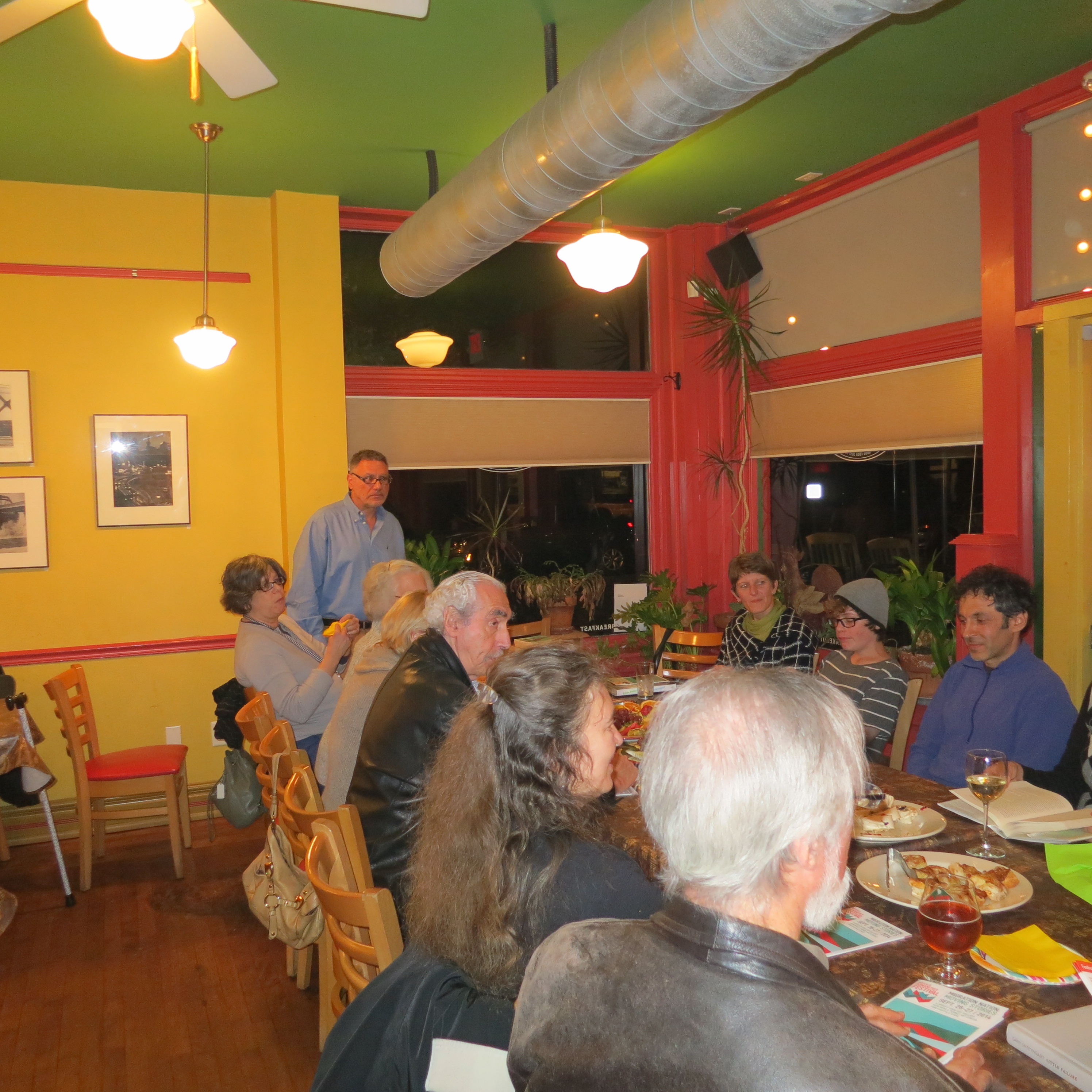
The Buffalo Humanities Festival Book Group met to discuss Gary Shteyngart’s memoir, Little Failure, at Betty’s Restaurant on Monday evening, September 22nd. Thanks so much to Erik Seeman, Humanities Institute Director, Betty’s Restaurant, and our guests for an engaging and amusing discussion of immigration, Jewish parenting, and childhood in the former Soviet Union.

Book Club at Betty's

Book Club at Betty’s

Book Club at Betty's

Book Club at Betty’s


Book Club at Betty's

Book Club at Betty’s


← Older posts
Newer posts →

Joseph Conte

Unknown's avatar

Professor of English
University at Buffalo

Recent Posts

  • Two book chapters on Don DeLillo
  • Northeast Modern Language Association Convention 2022
  • The Encyclopedia of American Fiction, 1980-2020
  • UB English News
  • Feminist Research Alliance Workshop

Archives

  • November 2023
  • April 2022
  • November 2020
  • October 2020
  • September 2020
  • December 2019
  • November 2019
  • October 2019
  • November 2018
  • September 2018
  • July 2018
  • June 2018
  • April 2018
  • February 2018
  • October 2017
  • September 2017
  • May 2017
  • February 2017
  • October 2016
  • February 2016
  • January 2016
  • October 2015
  • April 2015
  • March 2015
  • January 2015
  • October 2014
  • September 2014
  • August 2014
  • July 2014
  • June 2014
  • November 2013
  • October 2013
  • September 2013
  • August 2013
  • July 2013
  • May 2013
  • April 2013
  • March 2013
  • February 2013

Categories

  • Awards
  • Conferences
  • Events
  • Graduate Seminars
  • Interviews
  • Lectures
  • Publications
  • Teaching
  • Travel
  • Uncategorized
  • Undergraduate Courses

Meta

  • Create account
  • Log in
  • Entries feed
  • Comments feed
  • WordPress.com

Calendar

January 2026
M T W T F S S
 1234
567891011
12131415161718
19202122232425
262728293031  
« Nov    

Blog at WordPress.com.

  • Subscribe Subscribed
    • Joseph M. Conte
    • Already have a WordPress.com account? Log in now.
    • Joseph M. Conte
    • Subscribe Subscribed
    • Sign up
    • Log in
    • Report this content
    • View site in Reader
    • Manage subscriptions
    • Collapse this bar
 

Loading Comments...